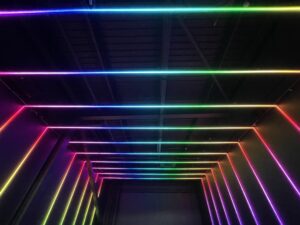
Lighting installations rarely happen in perfect conditions. Even with careful planning, site conditions can introduce unexpected challenges. For that reason, we sometimes bring our 3D printers on site during installations. This allows us to design and manufacture custom parts immediately if required.
Having this capability on site means we can solve technical problems in real time. Instead of delaying the programme or returning to the workshop, we can respond instantly. It also allows us to develop solutions directly within the live installation.
A recent project demonstrated exactly how valuable this approach can be.
The installation challenge
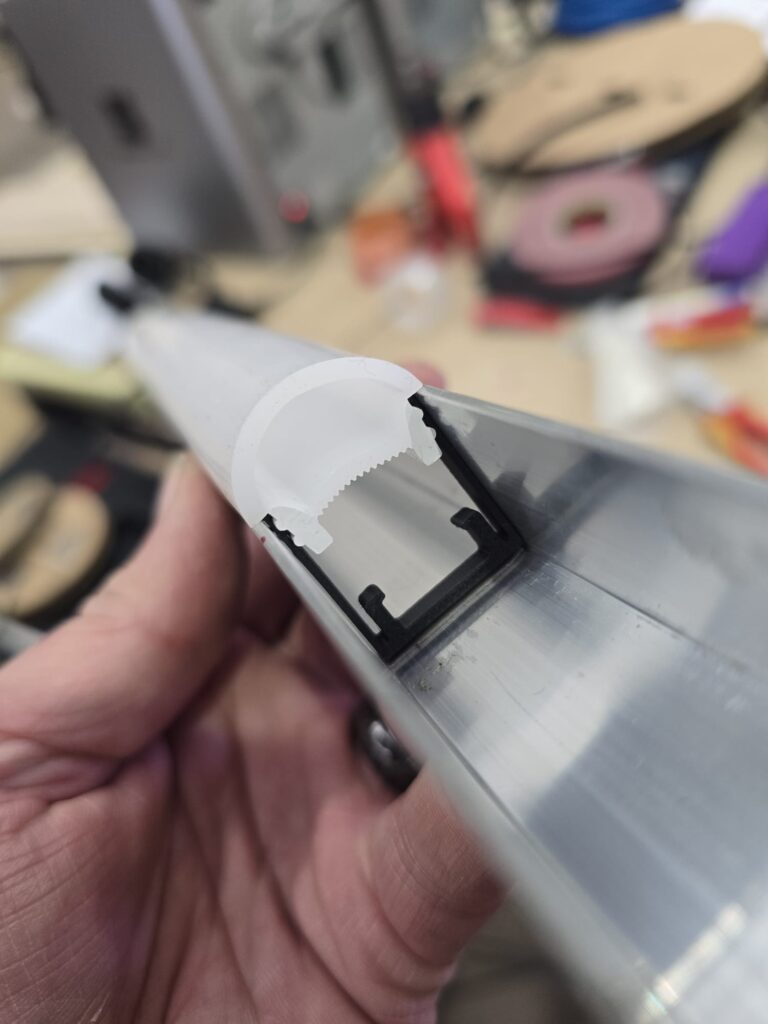
Our team spent four days working on site away from the workshop. The installation used a neon diffuser within a specific aluminium profile. During installation, we discovered the diffuser did not sit securely within the channel.
This created two practical issues. The diffuser did not produce a consistent visual finish. The structure also needed to be dismantled several times during de-rig. This meant the diffuser had to remain removable without damage.
Changing the aluminium profile was not a realistic option. It would have increased costs, created delays, and produced unnecessary waste. Instead, we focused on developing a solution that worked with the existing materials.
3D Printing a Custom Component on Site
Because we had brought our 3D printers, we could begin solving the issue immediately. While on site, we designed a bespoke retention clip specifically for the diffuser and aluminium profile.
We printed several prototype versions and tested them directly within the installation. Each version allowed us to refine the design based on real conditions.
The final component secured the diffuser cleanly within the profile while still allowing easy removal during de-rig. Importantly, it solved the issue without replacing any existing materials.
How 3D Printing Supports Custom Components in Lighting Installations
Custom 3D printing provides flexibility during lighting installations. It allows us to design solutions around real constraints rather than forcing compromises.
We regularly use this approach to create bespoke mounting solutions, specialist brackets for unusual geometries, custom spacers and fixings, and cable management components. It is also useful for temporary installations or touring structures where components must be assembled repeatedly.
You can see further examples of this approach in our previous blog, HERE.
Why Custom Components Improve Bespoke Lighting Projects
This method also supports better decision-making from a sustainability perspective. In this case, we avoided replacing usable aluminium profile and prevented unnecessary material waste.
We also removed the need for urgent replacement deliveries or additional manufacturing. Instead of replacing components, we adapted them intelligently.
Conclusion
Practical problem-solving is part of every envisio installation. Bringing our 3D printers on site allowed us to resolve an issue immediately and keep the project moving.
It also produced a cleaner and more reliable technical result. When projects involve bespoke lighting systems, small details often require custom solutions.
If your project requires bespoke lighting components or adaptive installation methods, our team can design, prototype, and manufacture solutions that suit real-world conditions.